
The Complete Guide to Aluminum Foil Packaging
When most people think of aluminum foil packaging, they picture rolls of foil in their kitchen drawer or takeout containers. But behind every food-grade container, pharmaceutical blister pack, or custom-printed flexible pouch lies a critical decision: where to source the material, and more importantly, who will convert it to your exact production specifications.
This distinction—between raw aluminum supply and converted packaging solutions—defines the modern aluminum foil supply chain. While massive mills produce the raw material, specialized converters like All Foils transform that material into production-ready packaging through coating, printing, slitting, and lamination services. For purchasing agents, R&D teams, and small-to-medium businesses, understanding this conversion lifecycle isn’t just technical knowledge—it’s supply chain security.
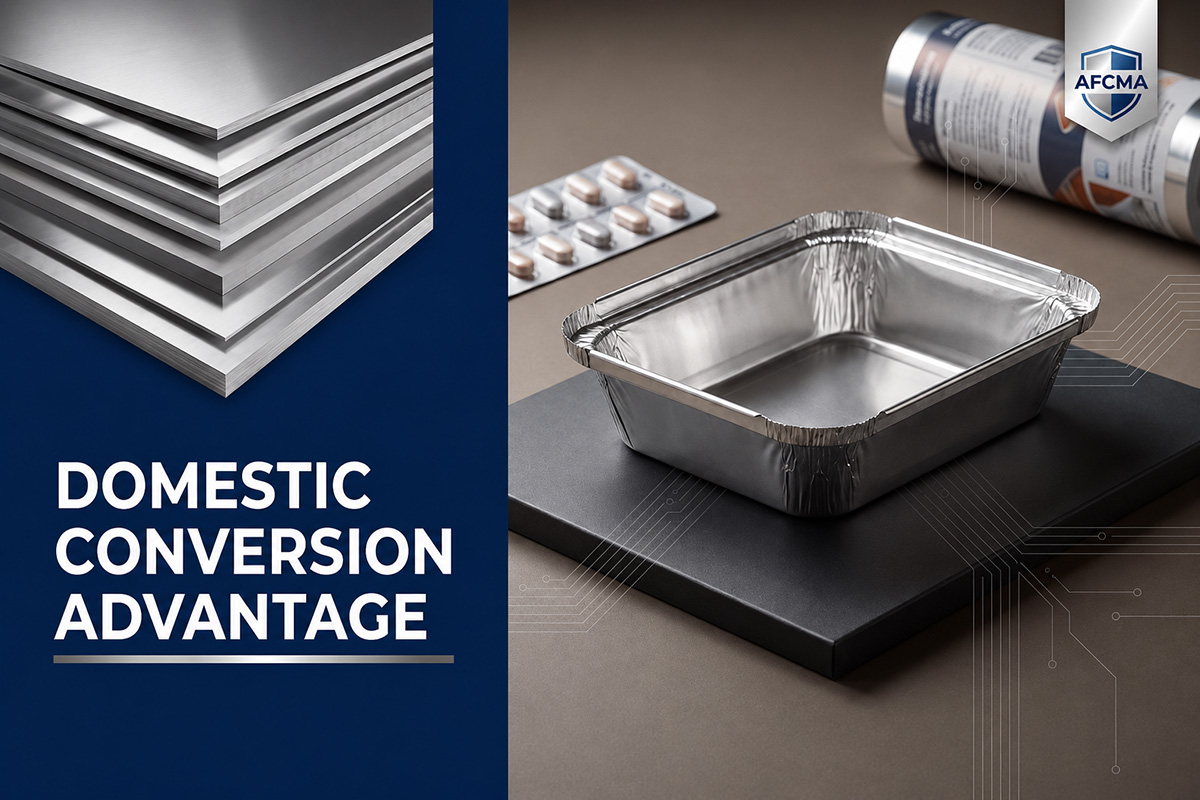
Beyond the Mill: Why Domestic Conversion Matters
The aluminum foil packaging industry has experienced significant disruption in recent years. Trade rulings against Chinese imports, anti-dumping duties, and extended lead times from overseas suppliers have made “domestic source” more than a preference—it’s become a supply chain necessity.
All Foils doesn’t just sell aluminum foil. As a specialized converter and proud member of the Aluminum Foil Container Manufacturers Association (AFCMA), the company represents a critical link between raw material and finished packaging. This means that whether you need food-grade containers, flexible packaging for pharmaceuticals, or custom-coated rolls for specialized applications, All Foils can supply the material and convert it to your precise specifications—all from a domestic facility.
This capability addresses a fundamental gap in the market. Large mills typically ship aluminum “as-is” with minimal customization and enormous minimum order quantities. Import suppliers offer lower prices but come with unpredictable lead times, quality inconsistencies, and the ever-present risk of sudden tariff changes. All Foils occupies the sweet spot: domestic reliability with custom conversion capabilities that most mills simply don’t offer.
The AFCMA Pillar: Advocacy and Protection for Domestic Producers

The Aluminum Foil Container Manufacturers Association (AFCMA) serves as both advocate and watchdog for the domestic aluminum foil container industry. As a member organization, AFCMA works to protect American manufacturers from unfair trade practices, lobby for reasonable regulations, and ensure that domestic producers can compete on a level playing field.
All Foils’ membership in AFCMA carries significant implications for customers. When you source from an AFCMA member, you’re not just buying aluminum—you’re buying into a supply chain protected by active trade advocacy. The association monitors import practices, files anti-dumping petitions when foreign competitors engage in predatory pricing, and maintains relationships with regulatory agencies to ensure domestic manufacturers aren’t disadvantaged by unfair competition.
Recent trade rulings illustrate why this matters. The U.S. International Trade Commission (USITC) has imposed substantial duties on certain Chinese aluminum imports after finding evidence of dumping—selling below fair market value to capture market share. Companies that relied heavily on these imports faced sudden price increases and supply disruptions. Those who partnered with AFCMA members like All Foils maintained stable pricing and uninterrupted supply.
Beyond trade protection, AFCMA membership signals a commitment to quality standards and domestic manufacturing practices. Members must meet rigorous requirements and maintain quality compliance standards that ensure food-grade safety, environmental responsibility, and consistent product specifications.
Flexible vs. Rigid: Choosing Your Aluminum Packaging Format

Aluminum foil packaging comes in two primary formats, each suited to different applications: flexible packaging and rigid containers. Understanding the distinction helps determine which format—and which aluminum alloy—best fits your needs.
Flexible aluminum packaging typically involves thin-gauge foil laminated to other materials like paper, plastic films, or polyester. This creates multi-layer barrier packaging ideal for food pouches, pharmaceutical blister packs, and candy wrap applications. The most common alloys for flexible packaging are 1235 and 8011, chosen for their excellent formability, barrier properties, and ability to accept coatings and printing.
The key advantage of flexible packaging lies in its versatility. Through laminating services, All Foils can combine aluminum with heat-sealable films, moisture barriers, or printable surfaces to create custom packaging constructions. A typical three-layer structure might include a printable outer layer, an aluminum barrier layer (preventing oxygen, moisture, and light transmission), and an inner heat-seal layer for closure integrity.
Rigid aluminum containers, by contrast, are formed from heavier-gauge foil into defined shapes: steam table pans, food service containers, pie plates, and storage containers. These applications typically use 3003 alloy, which offers greater stiffness and structural integrity necessary for maintaining shape under load and heat. Many rigid containers are designed for food and beverage applications where oven-safe, freezer-safe performance is required.
All Foils specializes in supplying material for both formats, but the company’s conversion capabilities truly differentiate the offering. Rather than simply shipping coils or sheets, All Foils can slit rolls to precise widths, apply protective or functional coatings, and even handle specialized treatments that prepare the material for your production line.
Custom Conversion Capabilities: The All Foils Difference

What separates a converter from a distributor? The answer lies in transformation services that turn standard aluminum foil into production-ready materials engineered to your specifications. All Foils offers comprehensive conversion services that address the full spectrum of customer needs.
Coating Services represent one of the most critical conversion capabilities. Not all aluminum foil comes ready for its end application. Heat-seal coatings enable aluminum to bond with plastic films for flexible packaging. Protective lacquers prevent corrosion or chemical reactions in pharmaceutical applications. Specialized HVAC films and lacquers optimize foil for heating and air conditioning applications where thermal performance matters.
All Foils maintains in-house coating capabilities that include pressure-sensitive adhesives, epoxies, urethanes, and custom formulations. This means shorter lead times—no waiting for material to ship to a third-party coater—and better quality control, since the entire conversion process happens under one roof.
Printing and Graphic Services transform plain aluminum into branded packaging. All Foils offers both color printing and graphic printing for retail packaging. Whether you need simple one-color or unique designs, the in-house printing capability ensures your aluminum packaging arrives production-ready with the exact appearance your brand requires.
For companies in the food and beverage sector especially, printed aluminum foil offers significant advantages: brand differentiation on shelf, tamper-evidence, and the premium appearance that aluminum naturally conveys.
Slitting and Sheeting may seem simple, but precision matters enormously in production environments. All Foils’ slitting services can convert master coils into rolls of any width from narrow strips to wide sheets, maintaining tight tolerance controls that ensure your material feeds smoothly through converting equipment. Similarly, sheeting services provide cut-to-length pieces that eliminate waste and prep time in your facility.
These capabilities matter because production efficiency depends on material that matches your equipment specifications exactly. A roll that’s one-eighth inch too wide can jam a packaging line. Sheets cut a half-inch short create gaps in coverage. All Foils’ precision conversion eliminates these costly disruptions.
The MOQ Gap Solution: Serving Orders the Big Mills Won’t

One of the most frustrating realities for small-to-medium businesses, R&D departments, and educational institutions is the minimum order quantity problem. Large aluminum mills and international distributors typically require large orders—quantities that make sense for massive food corporations but create impossible barriers for smaller operations.
All Foils deliberately addresses this gap. Whether you need 500 pounds for a pilot production run, specialized material for medical and pharmaceutical research, or small batches for educational applications, All Foils can accommodate orders that major mills refuse to consider.
This “MOQ inclusivity” reflects a fundamental business philosophy: innovation often happens at smaller scales. The next breakthrough in sustainable packaging might come from a university lab. A regional food producer might develop a product that requires custom foil specifications. A startup might need flexible packaging that existing suppliers can’t economically provide. By servicing these “smaller” orders, All Foils supports innovation across the entire aluminum packaging ecosystem.
The capability extends across the full product range—not just aluminum, but also copper, stainless steel, and specialty alloys available in coil, roll, and sheet formats. This breadth means you can develop prototypes, test market concepts, and scale production without changing suppliers or renegotiating specifications.
Applications Across Industries: Where Aluminum Foil Packaging Excels
Understanding what aluminum foil packaging is used for helps illustrate why domestic conversion capability matters so much. The applications span industries where quality, safety, and reliability cannot be compromised:
Food and Beverage: From flexible packaging pouches for coffee and snacks to containers and lids for yogurt and prepared meals, aluminum provides the ultimate barrier against oxygen, moisture, and light—the three enemies of food freshness. All Foils supplies material for cheese wrap, ham wrap, and specialized turkey wrap applications where maintaining product quality during storage and display is critical.
Pharmaceutical and Medical: Aluminum’s impermeability makes it essential for blister packaging that protects medications from humidity and contamination. The stringent regulatory environment demands suppliers with documented quality systems and full traceability—exactly what AFCMA membership and All Foils’ certifications provide.
Cosmetics and Personal Care: From packaging for serums and creams to lidding and wrapping for beauty and skincare products, aluminum foil provides an impermeable barrier that preserves formula integrity and extends shelf life. The cosmetics industry demands precise aesthetics alongside performance—consistent surface quality, printability, and compatibility with specialized coatings that only experienced converters can reliably supply.
Making the Right Sourcing Decision: Questions to Ask Your Supplier
When evaluating aluminum foil packaging suppliers, the questions you ask reveal whether you’re talking to a mere distributor or a true conversion partner:
- Can you coat and print to our specifications? If the answer is “we can source that” rather than “we do that in-house,” you’re adding lead time and coordination complexity.
- What are your actual minimum order quantities? Many suppliers advertise flexibility but enforce prohibitive MOQs through pricing or surcharges.
- Are you an AFCMA member? Membership signals commitment to domestic manufacturing and industry advocacy that protects your supply chain.
- What conversion services do you offer in-house? The more capabilities under one roof, the faster your turnaround and the better your quality control.
- Can you provide material-specific technical data? True expertise means understanding alloy properties, tempers, and surface treatments—not just reading from a catalog.
All Foils can answer these questions affirmatively because the company was built around conversion capability, not simple distribution. The services offered represent genuine in-house capabilities, not outsourced processes that add time and cost.
Supply Chain Security in an Uncertain World
The aluminum industry provides a case study in why supply chain resilience matters. Global disruptions—whether pandemic-related, geopolitical, or trade-related—have repeatedly demonstrated the vulnerability of long, complex supply chains. Companies that diversified away from single-source international suppliers maintained operations while competitors scrambled.
Domestic sourcing from AFCMA members like All Foils offers inherent advantages: shorter lead times (days instead of weeks), easier quality resolution, responsive customer service, and protection from international trade volatility. When shipping disruptions delay containers from Asia or new tariffs suddenly increase costs, domestic suppliers maintain steady operations.
This reliability extends beyond crisis management. It creates partnership opportunities impossible with distant suppliers. Need to adjust specifications mid-production? A domestic converter can accommodate. Want to test a new coating formulation? In-house capabilities enable rapid iteration. Require just-in-time delivery to minimize inventory costs? Proximity makes it feasible.
Next Steps: Partnering with a Domestic Conversion Specialist
Whether you’re developing new packaging for a food product, sourcing containers for a growing restaurant chain, or engineering specialized flexible packaging for pharmaceutical applications, the choice of aluminum supplier shapes your success.
All Foils combines domestic reliability, AFCMA advocacy, and comprehensive conversion services into a single partnership. Rather than coordinating between a mill, a coater, a printer, and a slitter, you work with one supplier who understands your complete requirement and delivers material ready for your production line.
The company’s commitment to serving smaller orders, custom specifications, and specialized applications means that whether you’re Fortune 500 or a five-person startup, you receive the same attention and expertise. Explore the full range of aluminum products available in coils, rolls, sheets, and adhesive-backed formats, or contact the All Foils team to discuss your specific requirements.
In a world where supply chains increasingly determine competitive advantage, choosing a domestic converter with comprehensive capabilities isn’t just a purchasing decision—it’s a strategic advantage that protects your operations, accelerates your innovation, and connects you to an industry association working to ensure domestic manufacturing remains viable and competitive.